Need exact pricing after reading? Jump straight to the AI API pricing table, the AI cost estimator, or the AI model cost comparison to price the workflow in this article with your own traffic and token counts.
Compare per-token prices across OpenAI, Claude, Gemini, DeepSeek, Mistral, and more.
Turn token counts and request volume into cost per request, daily spend, and monthly spend.
See which model is cheaper for the exact workload this article is talking about.
Real-SWE puts a spotlight on the problem engineering leaders have been seeing in production: public coding benchmarks are not enough to decide whether an AI coding agent is ready for an enterprise repo. A model can look strong on issue-resolution leaderboards and still fail when the real task requires internal service knowledge, repo-specific conventions, flaky integration tests, protected files, stale docs, private package permissions, or a senior reviewer’s unwritten rules.
The market cares because coding agents have moved from autocomplete into pull-request automation. Teams are asking agents to inspect tickets, modify multi-file code paths, run tests, respond to reviews, and propose deployable changes. That turns model choice into an operational decision, not a leaderboard decision. A failed agent run burns tokens, CI minutes, reviewer time, and trust.
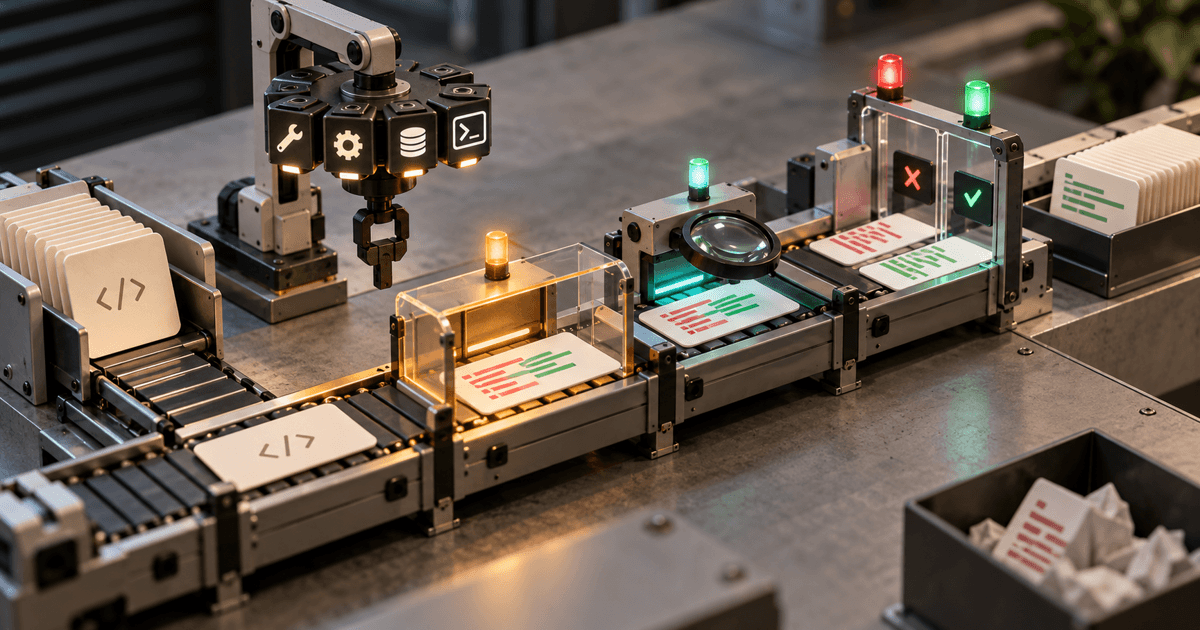
This post turns the Real-SWE lesson into a workflow your engineering team can copy: build a private coding-agent evaluation loop using representative tickets, regression tests, review gates, and model routing. You will learn what changed, what to measure, which workflows become possible, how to route premium agentic models versus cheaper fallbacks, and how to estimate costs before letting agents touch production branches.
💡 Key Takeaway: Treat public coding benchmarks as model discovery, not deployment approval. Production approval should come from private evals built from your own tickets, tests, permissions, conventions, and reviewer standards.
What changed: coding-agent evaluation is moving from public benchmarks to private repo proof
Real-SWE’s core message is timely because coding agents are now being evaluated against tasks that look more like actual software work: issue context, repository state, tests, patches, and agent behavior across a workflow. That is a better direction than single-function coding prompts, but enterprise teams still need a private layer on top.
Public benchmarks answer: “Can this model solve a representative open-source software issue?”
Private enterprise evals answer: “Can this agent safely solve our tickets in our codebase with our dependencies, test reliability, security rules, permissions, and review expectations?”
Those are different questions. An enterprise codebase contains hidden constraints that rarely appear in public benchmark tasks:
| Production constraint | Why public benchmarks miss it | Eval signal to add |
|---|---|---|
| Private dependencies | Models cannot infer internal package behavior | Build and integration-test success |
| Repo conventions | Naming, layering, lint rules, migration patterns | Static checks and reviewer rubric |
| Permission boundaries | Agents may not access secrets, prod configs, or restricted services | Sandbox and tool-access audit |
| Flaky tests | Passing once is not enough | Re-run policy and flake classification |
| Monorepo complexity | Small ticket can span services, schemas, and generated code | Multi-directory diff analysis |
| Review culture | “Works” is not the same as “mergeable” | Human review score and requested changes |
| Deployment risk | Correct patch can still break rollout assumptions | Canary, feature flag, rollback plan checks |
The practical shift is simple: stop asking “Which model tops the benchmark?” and start asking “Which model clears our private gate at the lowest cost per accepted PR?”
This unlocks a more reliable model strategy. Premium agentic models can handle ambiguous, multi-step implementation work. Cheaper models can triage tickets, summarize code, draft tests, or fix narrow lint failures. The best engineering orgs will not standardize on one model for every coding task. They will build routing rules from private eval data.
What Real-SWE-style evaluation makes possible for engineering teams
A private coding-agent eval loop is not just a safety exercise. It creates infrastructure your team can reuse for automation, onboarding, planning, and model procurement. Here are seven practical things you can build now.
1. A private coding-agent leaderboard for your repo
Instead of ranking models on generic coding ability, rank them on your accepted-ticket rate. Use 50 to 200 historical tickets across bug fixes, test updates, refactors, migrations, and small features. Run each agent in the same sandbox and score it on:
- Patch correctness
- Test pass rate
- Lint/typecheck pass rate
- Reviewer acceptance
- Security and permission compliance
- Cost per successful ticket
- Time to usable PR
This gives engineering leadership a procurement-ready artifact: “Model A costs more, but passes 18% more of our backend migration tickets. Model B is good enough for frontend copy and test maintenance.”
2. A regression suite for coding agents
Once agents start changing code, the agent itself becomes part of your delivery system. Model upgrades, prompt changes, tool changes, and repository restructuring can degrade performance. A private eval suite lets you regression-test the agent before changing the model or system prompt.
Run the same ticket set weekly or before any model upgrade. Track solve rate, average cost, tool-call count, hallucinated file edits, and reviewer rejection reasons.
3. Model routing by ticket class
Not every ticket deserves a premium coding model. A private eval loop lets you route tasks by difficulty.
| Ticket class | Recommended route | Reason |
|---|---|---|
| Typo, docs, config, simple tests | Cheap model | Low ambiguity, easy verification |
| Isolated bug with strong tests | Mid-tier coding model | Tests provide reliable feedback |
| Multi-file feature | Premium agentic model | Needs planning and repo navigation |
| Security-sensitive change | Premium model + human gate | High consequence of subtle mistakes |
| Database migration | Premium model + migration checklist | Hidden rollback and data constraints |
| Flaky test investigation | Specialist route with repeated test runs | Needs evidence, not just patching |
This is where cost savings become real. You do not save money by picking the cheapest model everywhere. You save money by avoiding premium models on simple work and avoiding cheap-model retries on hard work.
4. Review-gated autonomous PRs
A production-ready coding agent should not merge code directly. The safer workflow is autonomous PR creation with strict review gates:
- Agent reads ticket and repo context.
- Agent proposes plan.
- Agent edits code in sandbox.
- Agent runs tests and records evidence.
- Agent opens PR with summary, risk notes, and test output.
- Human reviewer approves, requests changes, or rejects.
- Eval system records outcome.
Over time, you can loosen or tighten gates by ticket class. For example, docs-only PRs can be auto-merged after checks pass, while auth, billing, or data migration changes always require senior review.
5. Failed-agent spend reporting
Failed agent runs are expensive because they combine model tokens, tool execution, CI, and reviewer attention. A private eval loop makes failed spend visible. Track:
- Cost per attempted ticket
- Cost per accepted ticket
- Retry count by model
- Reviewer minutes wasted per rejected PR
- CI minutes per agent attempt
- Most common failure category
A model with a higher token price can be cheaper if it gets accepted on the first run. A cheaper model can be expensive if it burns three retries and still needs a human rewrite.
6. Agent permission hardening
Private evals reveal where the agent asks for too much access. You can test whether it tries to read secrets, modify generated files, hit external services, or bypass failing tests. Build permission policies before production:
- Read-only access for discovery
- Write access only in branch sandbox
- No production secrets
- Approved package install list
- Network restrictions
- File path denylist
- Tool-call logging
7. Engineering onboarding and codebase documentation
The same ticket set can show where your codebase is hard to understand. If several strong models fail because internal patterns are undocumented, humans probably struggle too. Use failed evals to identify missing architecture docs, unclear test commands, brittle setup scripts, and ownership gaps.
[stat] 10x to 40x The practical cost spread between cheap coding-agent routing and premium-only routing on repeated enterprise ticket attempts
The private coding-agent eval architecture
A production-grade eval loop needs more than prompts. It needs a repeatable system that gives every model the same ticket, same repo state, same tools, and same scoring process.
Here is the reference architecture:
| Layer | What it does | Implementation detail |
|---|---|---|
| Ticket sampler | Selects representative historical or synthetic tickets | Pull from Jira, Linear, GitHub Issues |
| Repo snapshotter | Freezes codebase state before the fix | Use commit SHA and container image |
| Agent runner | Executes model with tools | Shell, editor, grep, test runner, PR tool |
| Sandbox | Prevents unsafe access | Ephemeral container with scoped credentials |
| Test harness | Runs unit, integration, lint, typecheck | Same commands as CI, plus reruns for flakes |
| Review gate | Scores patch quality | Human rubric or senior-engineer review |
| Cost logger | Captures model tokens and tool costs | Input/output tokens by step |
| Results warehouse | Stores pass/fail and failure reasons | BigQuery, Postgres, or analytics table |
| Router | Chooses model for future tasks | Rules from private eval performance |
The most important design choice is to evaluate complete workflows, not isolated answers. A coding agent should be judged on whether it produces a reviewable PR with evidence, not whether it writes a plausible code snippet.
⚠️ Warning: Do not let coding agents evaluate themselves as the final gate. Use automated tests, static checks, permission logs, and human review for production-impacting changes. Self-critique is useful for iteration, not approval.
Workflow 1: Build a private ticket eval set from historical engineering work
This workflow creates the foundation: a representative set of private tickets that agents must solve before production use.
Step 1: Select 50 to 200 closed tickets
Start with tickets that already have accepted human fixes. Include a balanced mix:
- 20% small bug fixes
- 20% test additions or test repairs
- 20% medium feature changes
- 15% refactors
- 10% dependency or config updates
- 10% database, schema, or API contract changes
- 5% security, permissions, or auth-sensitive changes
Avoid only selecting clean tickets. Enterprise value comes from messy integration work, so include tickets with ambiguous descriptions, multiple touched files, and non-obvious test commands.
Step 2: Reconstruct the pre-fix repo state
For each ticket, identify the commit before the human fix. Store:
- Repository URL or mirror reference
- Base commit SHA
- Ticket title and description
- Linked discussion or acceptance criteria
- Original human PR diff
- CI commands used
- Known flaky tests
- Files that should not be edited
This makes the task reproducible. The agent should start where the human started, not from the already-fixed code.
Step 3: Define the allowed context
Give the agent enough information to work, but not privileged knowledge from the future. Allow:
- Ticket description
- Current repo files at base commit
- Existing tests and docs
- Build scripts
- Internal package docs available at that time
Do not include the final human patch in the prompt. Use it only for scoring and comparison.
Step 4: Run each model in the same sandbox
Every model gets the same environment:
- Same container image
- Same time limit
- Same tool list
- Same retry policy
- Same test budget
- Same branch permissions
This prevents false conclusions. A model with better tools will look better even if the underlying model is not stronger.
Step 5: Score with a mergeability rubric
Use a 100-point rubric:
| Category | Points | Scoring rule |
|---|---|---|
| Functional correctness | 30 | Fixes ticket behavior |
| Test evidence | 20 | Adds/runs relevant tests |
| Code quality | 15 | Follows repo conventions |
| Minimality | 10 | Avoids unnecessary rewrites |
| Safety | 10 | No secrets, unsafe commands, or broad changes |
| Maintainability | 10 | Clear structure and naming |
| PR quality | 5 | Good summary, risk notes, and commands |
Set production thresholds. For example, require 80+ for autonomous PR creation and 90+ for any auto-merge candidate.
Step 6: Store costs and failure reasons
For every run, capture input tokens, output tokens, tool calls, wall-clock time, CI cost, reviewer score, and failure category. Use consistent labels:
- Misunderstood ticket
- Could not navigate repo
- Wrong abstraction
- Test failure
- Lint/type failure
- Overbroad diff
- Permission violation
- Incomplete PR evidence
- Flaky test confusion
Step 7: Convert results into routing rules
After 50 to 200 tickets, build routing rules:
- Cheap model for docs, tests, formatting, simple config
- Mid-tier coding model for isolated bugs with strong tests
- Premium model for multi-file implementation, architecture-sensitive changes, and ambiguous tickets
- Human-only for secrets, compliance, payments, and production incident patches
✅ TL;DR: A private eval set should reproduce the pre-fix state of real tickets, run every model in the same sandbox, score mergeability, and record cost per accepted PR. That gives you routing data you can trust.
Workflow 2: Add review gates to autonomous coding-agent PRs
Once your eval set identifies promising models, the next step is a gated production workflow. The goal is to let agents create useful PRs without giving them uncontrolled merge authority.
Step 1: Classify incoming tickets
Use labels or a triage model to classify every ticket by risk and complexity:
| Label | Examples | Gate |
|---|---|---|
| Low risk | Docs, copy, tests, comments | Auto PR after checks |
| Medium risk | Isolated bug, UI behavior, logging | Human review required |
| High risk | Auth, billing, permissions, migrations | Senior review required |
| Restricted | Secrets, incident response, legal/compliance | Human-only |
A cheap model such as GPT-5 nano, Gemini 2.5 Flash-Lite, or Mistral Small 4 can classify tickets at very low cost. Save premium models for implementation.
Step 2: Require a plan before edits
Before modifying files, the agent must produce:
- Problem summary
- Suspected files
- Proposed implementation steps
- Tests to run
- Risk areas
- Rollback considerations for risky changes
This plan is cheap compared with a failed implementation. For high-risk tickets, require human approval of the plan before edits.
Step 3: Run in a branch sandbox
The agent receives write access only in an ephemeral branch or workspace. It cannot push to protected branches, access production secrets, or alter CI configuration outside approved paths.
Log every shell command and file edit. If the agent attempts disallowed paths, terminate the run and record a permission failure in the eval dataset.
Step 4: Require evidence in the PR body
A coding-agent PR should include:
- Ticket summary
- Files changed and why
- Test commands run
- Full test result summary
- Known skipped or flaky tests
- Risk assessment
- Rollback plan if relevant
This is a review accelerator. If the agent cannot explain what it changed, the PR is not production-ready.
Step 5: Use automated and human review gates
The PR must pass:
- Formatting and lint
- Typecheck
- Unit tests
- Relevant integration tests
- Security scans for sensitive paths
- Human review for medium/high-risk work
For high-risk changes, require the reviewer to score the PR with the same rubric used in eval. That keeps production feedback connected to your private benchmark.
Step 6: Feed outcomes back into routing
Every PR outcome should update your routing table. If a cheap model repeatedly fails backend integration tickets, remove that route. If a premium model consistently handles migrations well, reserve it for those cases.
The loop is continuous: evaluate, route, review, record, improve.
Practical model stack for enterprise coding-agent evals
A strong coding-agent stack uses multiple models rather than one model for every step. The best model for implementation is not always the best model for triage, summarization, review, or cost control.
| Workflow step | Recommended model tier | Example models | Why |
|---|---|---|---|
| Ticket triage | Cheap/fast | GPT-5 nano, Gemini 2.5 Flash-Lite, DeepSeek V4 Flash | Low-cost classification |
| Repo summarization | Cheap long-context | Gemini 3 Flash, Grok 4.1 Fast, Llama 4 Scout | Large context at lower cost |
| Implementation | Coding/premium | GPT-5.3 Codex, Claude Sonnet 5, Claude Opus 5 | Strong code editing and reasoning |
| Hard debugging | Premium reasoning | GPT-5.2 pro, o3-pro, Claude Fable 5 | Ambiguous failures and deep analysis |
| Review assistant | Mid-tier | GPT-5.2, Gemini 3 Pro, Claude Sonnet 5 | Diff review and risk analysis |
| Cheap fallback | Budget | DeepSeek V3.2, Mistral Large 3, GPT-5 mini | Narrow fixes and retries |
For coding-specific work, GPT-5.3 Codex is a strong default candidate because it is priced at $1.75 input / $14 output per 1M tokens with a 256,000-token context window. For broader agentic implementation, Claude Sonnet 5 at $2 input / $10 output per 1M tokens and 1,000,000-token context is a practical premium route. Claude Opus 5 costs $5 input / $25 output per 1M tokens, so reserve it for tickets where correctness, planning, and review quality justify the premium.
If your team is already comparing frontier models, use the GPT-5 vs Claude Opus 4.6 comparison and GPT-5 vs Gemini 3 Pro comparison as a starting point, then validate against your private eval.
Model Choice and Cost: premium agents versus cheaper fallbacks
Cost analysis for coding agents must be task-based. A single agent attempt often includes ticket reading, repo search, planning, code edits, test interpretation, PR writing, and review response. That can easily reach tens or hundreds of thousands of tokens.
For a realistic enterprise coding-agent run, assume:
- 120,000 input tokens from ticket context, repo snippets, tool outputs, and test logs
- 20,000 output tokens from plans, code patches, explanations, and PR content
- One complete attempt, excluding CI infrastructure cost
Using current pricing:
| Model | Input / output price per 1M tokens | Estimated cost per run | Cost per 1,000 runs | Best use |
|---|---|---|---|---|
| GPT-5.3 Codex | $1.75 / $14 | $0.49 | $490 | Default coding-agent implementation |
| Claude Sonnet 5 | $2 / $10 | $0.44 | $440 | Premium implementation with long context |
| Claude Opus 5 | $5 / $25 | $1.10 | $1,100 | Hard multi-file or ambiguous changes |
| GPT-5.2 pro | $21 / $168 | $5.88 | $5,880 | Deep debugging and critical changes |
| o3-pro | $20 / $80 | $4.00 | $4,000 | Complex reasoning and failure analysis |
| GPT-5 mini | $0.25 / $2 | $0.07 | $70 | Simple fixes and cheap fallback |
| DeepSeek V3.2 | $0.28 / $0.42 | $0.042 | $42 | Low-cost triage and narrow edits |
| Mistral Large 3 | $0.5 / $1.5 | $0.09 | $90 | Budget implementation and review |
| Gemini 2.5 Flash-Lite | $0.1 / $0.4 | $0.02 | $20 | Classification, summaries, small tasks |
The cheapest model is not automatically the cheapest workflow. If DeepSeek V3.2 needs four attempts and still requires a human rewrite, the real cost includes reviewer time and delay. If Claude Sonnet 5 solves the ticket once and produces a clean PR, its $0.44 model cost can be the better business decision.
Recommended routing rules
Use this routing policy as a starting point:
| Task type | Primary model | Cheaper fallback | Premium escalation |
|---|---|---|---|
| Ticket classification | GPT-5 nano | Gemini 2.5 Flash-Lite | None |
| Docs or comments | DeepSeek V3.2 | Mistral Small 4 | GPT-5 mini |
| Unit test generation | GPT-5 mini | Mistral Large 3 | Claude Sonnet 5 |
| Isolated bug fix | GPT-5.3 Codex | Mistral Large 3 | Claude Sonnet 5 |
| Multi-file feature | Claude Sonnet 5 | GPT-5.3 Codex | Claude Opus 5 |
| Ambiguous production bug | Claude Opus 5 | Claude Sonnet 5 | GPT-5.2 pro |
| Security-sensitive change | Claude Opus 5 + human | None | Human-only |
| Deep failing-test analysis | o3-pro | Claude Sonnet 5 | GPT-5.2 pro |
Premium models are overkill for classification, docs, formatting, simple test snapshots, translation of error logs, and PR summaries. Use cheaper models there. Premium models are justified when the task requires long-horizon planning, cross-service reasoning, hidden dependency inference, or careful tradeoff explanation.
📊 Quick Math: If your team runs 5,000 coding-agent attempts per month, routing all attempts to Claude Opus 5 at $1.10/run costs about $5,500/month in model usage. A mixed route with 50% DeepSeek V3.2, 30% GPT-5.3 Codex, and 20% Claude Sonnet 5 costs about $1,007/month before CI and review time.
Use AI Cost Check to adjust these estimates with your actual input/output token mix. Coding-agent workloads with huge test logs can skew heavily toward input tokens, while review-response loops can increase output tokens.
How to decide whether a coding agent is production-ready
A coding agent is production-ready for a ticket class when it clears measurable thresholds in your private environment. Do not approve a model globally. Approve model-task pairs.
Use these gates:
| Gate | Production threshold |
|---|---|
| Eval set size | Minimum 50 tickets for pilot, 200 for broad rollout |
| Mergeable PR rate | 70%+ for low-risk, 85%+ for high-value automation |
| Permission violations | 0 tolerated in production pilot |
| Test evidence quality | 90%+ of PRs include relevant commands and results |
| Overbroad diffs | Under 5% of accepted PRs |
| Reviewer rejection for misunderstanding | Under 10% |
| Cost per accepted PR | Below your internal engineering-time benchmark |
| Regression stability | No major drop across two consecutive eval runs |
The best single metric is cost per accepted PR, not cost per run. Calculate:
Cost per accepted PR = total model cost + CI cost + reviewer time cost / accepted PR count
If a model costs $0.50 per attempt but produces a clean PR in one run, it beats a $0.05 model that fails repeatedly and consumes a senior engineer’s review time.
Also measure time-to-merge. Coding agents can produce fast drafts that sit in review because the patch is hard to trust. A useful PR should include enough evidence to reduce reviewer burden.
Risks, limits, and when not to use AI coding agents
Real-SWE-style evaluation reduces risk, but it does not remove it. Coding agents should be constrained in production, especially in complex enterprise systems.
Do not use autonomous agents for these tasks
- Production incident mitigation without human command
- Secrets, key rotation, or credential handling
- Payment logic changes without senior review
- Compliance, legal, or audit-sensitive code
- Large architectural rewrites
- Database migrations without rollback validation
- Security patches where exploitability analysis is required
- Code where tests are known to be weak or missing
Watch for hidden cost traps
Coding-agent costs do not come only from token prices. Watch for:
- Repeated test logs pasted into context
- Agents running full integration suites too often
- Long review-response loops
- Retry storms after flaky failures
- Overuse of premium models on small tickets
- Agents reading entire monorepo context instead of targeted files
- CI minutes from failed branches
- Human review time for low-quality PRs
Control the context window
Long-context models are useful, but dumping the whole repo into context is wasteful. Use search and retrieval first. Feed the model targeted files, dependency graphs, test output, and conventions. For very large monorepos, build a repo map and let the agent request files on demand.
Treat model upgrades as breaking changes
A newer model can be worse for your conventions, tools, or prompts. Before switching from one model to another, run the private eval suite and compare:
- Accepted PR rate
- Average run cost
- Tool-call count
- Permission issues
- Review quality
- Failure categories
Model upgrades should go through the same release discipline as compiler upgrades or CI changes.
Implementation checklist for the next 30 days
Here is a practical rollout plan.
Week 1: Build the eval foundation
- Select 50 historical tickets
- Reconstruct base commits
- Create containerized sandbox
- Define allowed tools and denied paths
- Write scoring rubric
- Decide initial model candidates
Start with three models: one cheap fallback, one coding default, and one premium escalation. For example: DeepSeek V3.2, GPT-5.3 Codex, and Claude Sonnet 5.
Week 2: Run baseline evals
- Run each model on the same tickets
- Capture token usage and tool logs
- Score PRs with the rubric
- Record failure categories
- Calculate cost per accepted PR
- Identify ticket classes where each model wins
Do not tune prompts after every failure. First run the baseline consistently so you have comparable data.
Week 3: Add routing and review gates
- Define ticket classification labels
- Route low-risk tasks to cheaper models
- Route ambiguous work to premium models
- Require plan-before-edit for medium/high-risk tickets
- Require PR evidence templates
- Connect reviewer feedback to eval records
Week 4: Pilot on live tickets
- Start with low-risk and medium-risk tickets
- Require human review on all agent PRs
- Track accepted PR rate
- Track reviewer time
- Track failed-agent spend
- Run a weekly regression eval
- Update routing rules
At the end of 30 days, you should have a private leaderboard, a cost model, and a production policy for which coding-agent workflows are safe.
Frequently asked questions
What is Real-SWE and why does it matter for AI coding agents?
Real-SWE is part of the broader shift toward evaluating coding agents on realistic software-engineering tasks instead of isolated coding prompts. It matters because enterprise success depends on repo integration, tests, permissions, conventions, and reviewability, not just benchmark problem solving.
How much does a coding-agent run cost?
A realistic coding-agent attempt with 120,000 input tokens and 20,000 output tokens costs about $0.042 on DeepSeek V3.2, $0.49 on GPT-5.3 Codex, $0.44 on Claude Sonnet 5, and $1.10 on Claude Opus 5. Use AI Cost Check to recalculate with your actual token mix.
Which model should we use for enterprise coding agents?
Use GPT-5.3 Codex or Claude Sonnet 5 as the default implementation tier, DeepSeek V3.2 or GPT-5 mini for cheaper low-risk work, and Claude Opus 5 for ambiguous multi-file changes. Approve each model by ticket class after private evals.
How many private tickets do we need for a useful coding-agent eval?
Start with 50 historical tickets for a pilot and expand to 200 before broad rollout. Include bugs, tests, refactors, config updates, migrations, and security-sensitive examples so your eval reflects real engineering work.
When should we not use AI coding agents?
Do not use autonomous coding agents for production incidents, secrets, payment logic, compliance-sensitive code, large architecture rewrites, or database migrations without senior review. Use agents to draft and test, but keep human approval for high-risk changes.
CTA: build your private coding-agent cost and eval plan
Real-SWE’s practical lesson is clear: public benchmarks help you shortlist models, but private enterprise evals decide production readiness. Build a ticket-based eval loop, measure mergeable PR rate, record failed-agent spend, and route models by task difficulty.
Next steps:
- Estimate your own model costs with AI Cost Check
- Compare frontier options with GPT-5 vs Claude Opus 4.6
- Review budget alternatives with GPT-5 vs DeepSeek V3.2
- Open model details for GPT-5.3 Codex, Claude Sonnet 5, and DeepSeek V3.2
The winning workflow is not “pick the top benchmark model.” It is “prove the agent on your tickets, in your repo, with your tests, then route every task to the cheapest model that reliably produces a mergeable PR.”
Related Cost Guides
Keep going with the closest pricing and optimization guides in this cluster.
Cognition SWE-2: 6 Coding-Agent Workflows Engineering Teams Can Use Now
How teams can use Cognition SWE-2 for repo triage, issue reproduction, patch planning, tests, review, and escalation routing.
The Log Is the Agent: How to Build Reliable AI Workflows in 2026
A practical guide to log-first AI agents: seven workflows, two build plans, model routing, cost math, and the failure modes to avoid.
AI API Quality Routing in 2026: How Model Routing Cuts Costs 50-80%
AI API quality routing sends each request to the cheapest model that still clears your quality bar. Use this 2026 guide to build a 3-tier router, cut AI API costs 50-80%, and reserve flagship models for hard requests.