Need exact pricing after reading? Jump straight to the AI API pricing table, the AI cost estimator, or the AI model cost comparison to price the workflow in this article with your own traffic and token counts.
Compare per-token prices across OpenAI, Claude, Gemini, DeepSeek, Mistral, and more.
Turn token counts and request volume into cost per request, daily spend, and monthly spend.
See which model is cheaper for the exact workload this article is talking about.
Recent agent research is converging on a blunt idea: the log is not just exhaust. The log is the thing that keeps an agent honest. If you want AI systems that can remember what they did, recover from failure, explain why they made a decision, and hand work to a human without turning into mush, you need to stop treating logs as boring backend plumbing.
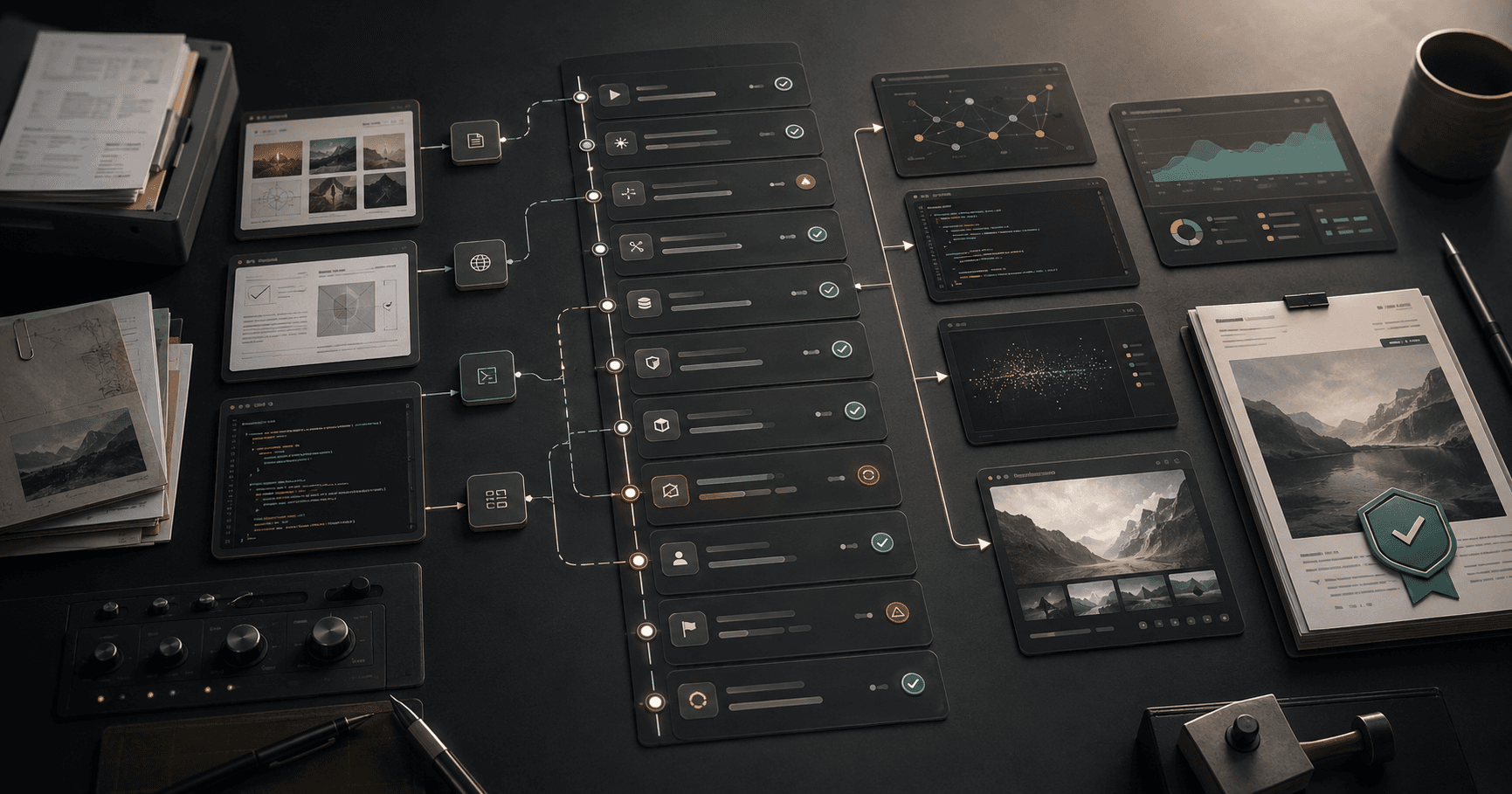
That changes the shape of practical AI workflows. The weak version of an agent keeps everything inside one giant prompt, forgets state after a few tool calls, and becomes impossible to debug when something goes sideways. The strong version writes decisions, tool outputs, checkpoints, retries, and evidence into a structured event log. That log becomes the memory layer, the recovery layer, the audit trail, and the control surface.
This is the market-facing part that matters: log-first agents are much easier to trust in real work. They make support operations, coding agents, browser automations, document review, and research workflows more usable because a human can inspect what happened instead of staring at a polished final answer and hoping it is true. Cost still matters, but cost is the proof layer. The headline is that better logging makes higher-agency automation practical.
💡 Key Takeaway: If you want reliable agents, log every decision that changes state. Prompts are temporary. Logs are the thing your system can actually reason over, retry from, verify, and explain.
What changed: builders are moving from prompt memory to event memory
The old agent pattern was basically long-context denial. Every time the model made progress, developers stuffed more state back into the prompt and prayed the model would preserve the right details. That works for demos. It breaks the second you need retries, human review, cross-session memory, or a clear explanation of what happened at step 17.
A log-first design flips that around. Instead of asking the model to remember everything, you ask the system to remember everything. The model sees only the slices it needs right now:
- the current objective
- the last accepted checkpoint
- the most relevant tool results
- the explicit failure state if something broke
- the policy constraints for the next action
The rest lives in the event log. That means your orchestration layer can summarize old steps, fork tasks, roll back to a known-good point, or trigger a different model without losing continuity.
Why this matters now:
| Shift | What it enables |
|---|---|
| Longer-running agents | State survives beyond one prompt window |
| Better tool use | Every tool call can be recorded, scored, and retried |
| Human oversight | Reviewers can inspect the chain of evidence, not just the answer |
| Cheaper routing | Expensive models only need the relevant slice of state |
| Safer automation | You can gate sensitive actions based on logged intent and evidence |
This is also why a log-first architecture pairs nicely with GPT-5 mini, Claude Sonnet 4.6, GPT-5.3 Codex, and DeepSeek V4 Flash. Once the state is structured, you can swap models by task instead of running every step on the same expensive model.
⚠️ Warning: A verbose log is not the same thing as a useful log. If you dump raw noise into state and feed it back to the model unchanged, you have just invented a more expensive prompt.
Why logs beat prompt stuffing
Prompt stuffing fails for four predictable reasons.
First, it turns memory into token spend. Every retry, tool result, and dead-end branch gets paid for again. Second, it hides failure. The model can smooth over contradictions instead of surfacing them. Third, it destroys recovery. If step 14 was bad, there is no clean checkpoint to resume from. Fourth, it makes audits miserable because the interesting state is buried inside a giant blob of conversation.
A structured event log fixes that if you keep it opinionated. Every event should answer one question: what changed that a future model call, human reviewer, or automated policy engine needs to know?
Useful event types:
task_createdplan_acceptedtool_calledtool_resultevidence_savedcheckpoint_writtenpolicy_blockedhuman_approvedretry_scheduledtask_completed
That structure gives you deterministic leverage. You can summarize five tool results into one checkpoint, mark one result as untrusted, or force the next model call to see only approved evidence.
[stat] 90%+ smaller active context In most production agents, only a small slice of the full task history is needed for the next decision. A log-first system lets you compact the rest instead of paying to resend it.
Here is the practical difference:
That gap matters because the log lets you reserve premium calls for planning, synthesis, or review while cheap models process ordinary steps.
Seven AI workflows that get better when the log is the agent
1. Support operations agents
A support agent should never just answer the customer. It should log the intent, evidence used, policy checks, draft response, escalation reason, and follow-up action. That makes refunds, account changes, and compliance-sensitive responses reviewable instead of magical.
The best use case is not generic chat support. It is high-volume ticket operations where the system needs to classify, retrieve, draft, and then either execute or escalate.
2. Coding agents with checkpointed retries
Coding agents become much more reliable when the plan, searched files, test output, failed hypotheses, and accepted patch decisions are all logged as state transitions. If the test loop breaks, the agent can restart from the last valid checkpoint instead of rerunning the whole reasoning chain.
This is where GPT-5.3 Codex shines as the execution model while Claude Sonnet 4.6 or a stronger planner handles difficult architectural calls.
3. Research analysts with evidence trails
Research agents should log source intake, extracted claims, contradictions, confidence scores, and recommendation drafts. That makes it possible to review whether a market claim came from a primary source or from the model inventing connective tissue.
If you publish research, pitch to clients, or brief executives, this one change is the difference between useful synthesis and expensive fan fiction.
4. Browser automations with policy gates
Browser agents are powerful but dangerous. A log-first browser agent records page state, intended action, form diff, approval status, and final outcome. That means a human can approve "prepare the payment" while still blocking "submit the payment."
This is exactly where you want logs as the control surface, not just the postmortem.
5. Document review and decision systems
Invoices, contracts, claims, RFPs, and onboarding packets all benefit from logged evidence. The agent should record the extracted fields, missing data, flagged anomalies, and final recommendation so a reviewer can see why it approved or rejected something.
That also makes model routing easier: use a cheap extractor first, then hand only risky cases to a stronger model.
6. QA and eval harnesses
An eval agent should log the prompt version, model version, rubric, outputs, failure labels, and regression notes. Otherwise every "the model got worse" debate becomes vibes and screenshots.
If your product depends on agents, your log is the source of truth for quality drift.
7. Multi-step internal workflows
Think weekly campaign reporting, CRM cleanup, procurement review, sales handoff prep, or knowledge-base maintenance. These jobs are not hard because of raw intelligence. They are hard because state moves across systems. A log-first agent makes every handoff explicit and reversible.
✅ TL;DR: The best log-first workflows are the ones where a human might later ask: what happened, why did it do that, and where can I safely resume?
Build pattern 1: a log-first support operations agent
Support ops is a good first implementation because the workflow has clear states and expensive mistakes. You want the agent to move fast, but you do not want it freelancing refunds, policy exceptions, or compliance language.
Step-by-step implementation
-
Define the event schema. Store ticket ID, customer intent, account context, retrieved knowledge articles, draft actions, policy checks, and escalation status.
-
Split the workflow into decision stages. A good default is classify, retrieve, draft, check policy, request approval if needed, then send or escalate.
-
Route cheap steps to cheap models. Use Gemini 2.5 Flash-Lite at $0.10 input / $0.40 output per 1M tokens or DeepSeek V4 Flash at $0.14 / $0.28 for classification and extraction.
-
Use a stronger model only when judgment matters. When the issue is ambiguous, emotional, or policy-sensitive, escalate the next state transition to Claude Sonnet 4.6 at $3 / $15 or your premium reviewer route.
-
Log every nontrivial action. The important thing to log is not only the final answer. Log the retrieved article IDs, the policy rule used, the refund reason, the handoff trigger, and the approved final message.
-
Add human checkpoints. Require explicit approval for credit issuance, account suspension, legal language, or anything that changes money or permissions.
-
Summarize the closed loop. When the ticket ends, save a compact "case memory" record so the next model call does not need the full raw history.
Cost math
Assume one ticket uses:
- 3 cheap extraction/classification calls
- 1 stronger synthesis call
- 1 final cheap formatting call
If the cheap steps each use 4,000 input tokens and 400 output tokens on GPT-5 mini, each step costs about:
- input: 4,000 x $0.25 / 1M = $0.001
- output: 400 x $2 / 1M = $0.0008
- total: $0.0018
Three such steps cost $0.0054.
If the synthesis step uses 12,000 input tokens and 1,000 output tokens on Claude Sonnet 4.6, that costs:
- input: $0.036
- output: $0.015
- total: $0.051
Add one more cheap formatting step and a typical routed support workflow lands around $0.058-$0.060 per ticket. Run everything on Sonnet and you roughly double the bill without getting meaningfully better extraction quality.
That is the core argument for log-first routing: the log holds the state so your expensive model does not need to do every tiny step.
Build pattern 2: a coding agent that can recover instead of restart
Coding agents fail in one extremely annoying way: they make partial progress, hit a bad test output, and then lose the thread. A log-first design fixes that because the system can checkpoint intent, file targets, failed hypotheses, and accepted patches between loops.
Step-by-step implementation
-
Create a task record with explicit success criteria. Include bug description, expected behavior, target files, test command, and rollback conditions.
-
Force a planning event before edits. The agent should log a root-cause hypothesis and the files it intends to inspect before touching code.
-
Separate read, edit, and verify phases. Each phase writes back into the event stream. That gives you a stable checkpoint after search, after patch, and after tests.
-
Use GPT-5.3 Codex for active code editing. At $1.75 input / $14 output per 1M tokens, it is much cheaper than using a premium general model for every edit loop.
-
Use a reviewer route for risky merges. When the patch touches architecture, auth, payments, or migration logic, send the compressed log plus diff summary to Claude Sonnet 4.6 for final review.
-
Store failed branches. Do not hide them. If the model already tried one approach and broke three tests, the next loop should know that path is poisoned.
-
End with a mergeable artifact. Log the PR summary, changed files, tests run, screenshots if UI, and residual risk.
Cost math
A medium coding task might look like:
- search + plan on Sonnet: 18,000 input / 1,200 output
- 3 edit loops on GPT-5.3 Codex: each 10,000 input / 1,000 output
- final review on Sonnet: 10,000 input / 800 output
Approximate total:
- Sonnet planning: $0.054 + $0.018 = $0.072
- Three Codex edit loops: each $0.0175 + $0.014 = $0.0315, total $0.0945
- Sonnet review: $0.03 + $0.012 = $0.042
Total routed cost: about $0.2085 per coding task.
If you run the whole thing on Sonnet instead, the same token shape comes out closer to $0.27-$0.30. That is not catastrophic for one task. At 5,000 coding tasks, it is real money. More importantly, the log-first version is easier to recover and easier to review.
📊 Quick Math: Saving even $0.06 per coding task is a $300/month difference at 5,000 tasks. Cheap model routing is boring until finance asks why your agent bill doubled.
Model choice: what to use for each layer
The cleanest architecture is not "pick one model." It is "pick one role per layer."
| Workflow layer | Recommended model | Why |
|---|---|---|
| Cheap extraction | Gemini 2.5 Flash-Lite | Lowest-cost high-volume parsing and summarization |
| Ticket and ops routing | GPT-5 mini | Cheap enough for broad classification and formatting |
| Code editing | GPT-5.3 Codex | Strong for repo search, edits, and test loops |
| Large-context synthesis | Claude Sonnet 4.6 | Better judgment for review, planning, and explanation |
| Bulk low-cost automation | DeepSeek V4 Flash | Useful when volume matters more than polish |
| Research-specific deep pass | o4-mini Deep Research | Good for sourced synthesis when the workflow warrants it |
The log is what makes this routing sane. Without a log, model switching becomes chaotic because each model inherits a half-broken prompt blob. With a log, every model gets the minimum viable state for its role.
For teams still learning the pattern, start with one expensive route and one cheap route. Do not over-engineer a six-model router on day one. Build the logging discipline first.
Risks, limits, and when not to use this approach
Log-first systems are better, but they are not free.
The first risk is schema bloat. If your event model is sloppy, you create state nobody trusts. The second risk is compliance sprawl. If sensitive data enters the log without redaction rules, you have built a memory leak with great observability. The third risk is false confidence. A complete-looking log does not guarantee a correct decision; it only guarantees you can inspect how the system got there.
Do not use this approach when:
- the task is a one-shot user chat with no lasting consequence
- the workflow has no meaningful state transitions
- a deterministic script can do the job cheaper
- the cost of designing the log schema exceeds the value of automation
Do use it when:
- the workflow spans tools, files, or approvals
- humans need to review or resume the task
- cost routing matters
- you care about debugging, auditability, or reliability
If you are deciding between "build an agent" and "build a logged workflow with model assistance," choose the second one. It is less sexy and much more useful.
Frequently asked questions
What does "the log is the agent" actually mean?
It means the durable system state lives in structured events, checkpoints, and evidence records rather than inside one huge prompt. The model reasons over that logged state instead of pretending to remember everything itself.
Which model should I use first for a log-first AI workflow?
Start with GPT-5 mini for cheap routing and Claude Sonnet 4.6 for harder review or synthesis. That gives you a clear cost-performance split without making the stack ridiculous.
How much does a routed log-first agent cost?
For many support or internal ops workflows, a routed design can stay around $0.03 to $0.10 per task. Coding and research agents often land higher because they need more context and better review passes.
Why not just give the model a bigger context window?
A bigger context window helps, but it does not solve recovery, auditability, approval gates, or cost control. Logs solve workflow structure. Long context only solves one piece of the memory problem.
Is this approach only for developers?
No. Developers build the plumbing, but operators, agencies, support teams, and research teams benefit most because they are the ones who need stateful, reviewable automation instead of clever demos.
Try the routing math before you build
The fastest way to sanity-check a log-first workflow is to model the token budget for each step before you ship it. Use AI Cost Check to compare planner, extractor, and reviewer models side by side, then read What Are AI Tokens? if you need a refresher on how token pricing compounds across multi-step systems.
If you already know your agent is doing too much on one expensive model, the next move is simple: log the workflow, split the state transitions, and route the boring steps to cheaper models. That is how you get agents that are easier to trust and much cheaper to run.
Related Cost Guides
Keep going with the closest pricing and optimization guides in this cluster.
AX Agent Orchestrator: 6 Production Workflows Founders and Operators Can Build Now
How to use Google's AX agent orchestrator for traceable research, support, coding, data enrichment, and back-office workflows.
Agentic Context Management: How to Build AI Agents That Remember the Right Things
A practical guide to agentic context management for reliable coding agents, support copilots, research agents, and ops workflows.
Mistral Studio as an AI Operations Workbench: 7 Agent Workflows Teams Can Build Now
How founders and operators can use Mistral Studio to build reusable AI agent workflows for support, research, evals, and approvals.