Need exact pricing after reading? Jump straight to the AI API pricing table, the AI cost estimator, or the AI model cost comparison to price the workflow in this article with your own traffic and token counts.
Compare per-token prices across OpenAI, Claude, Gemini, DeepSeek, Mistral, and more.
Turn token counts and request volume into cost per request, daily spend, and monthly spend.
See which model is cheaper for the exact workload this article is talking about.
IEEE Spectrum’s latest reporting on growing evidence that autonomous cars save lives marks a useful shift: autonomous vehicles are no longer only a robotics moonshot or valuation story. They are becoming a measured safety operations problem. The market now needs repeatable ways to review driving video, sensor logs, interventions, near misses, insurance claims, and compliance evidence at scale.
That is where AI teams can do something practical today. If autonomous systems are moving from hype to measurable safety outcomes, fleet operators, insurers, mobility startups, and city transportation teams need workflows that turn raw driving data into auditable evidence. The useful question is not “are self-driving cars good or bad?” The useful question is: how do we build reliable review pipelines that prove safety, find edge cases, and control cost while processing millions of frames and logs?
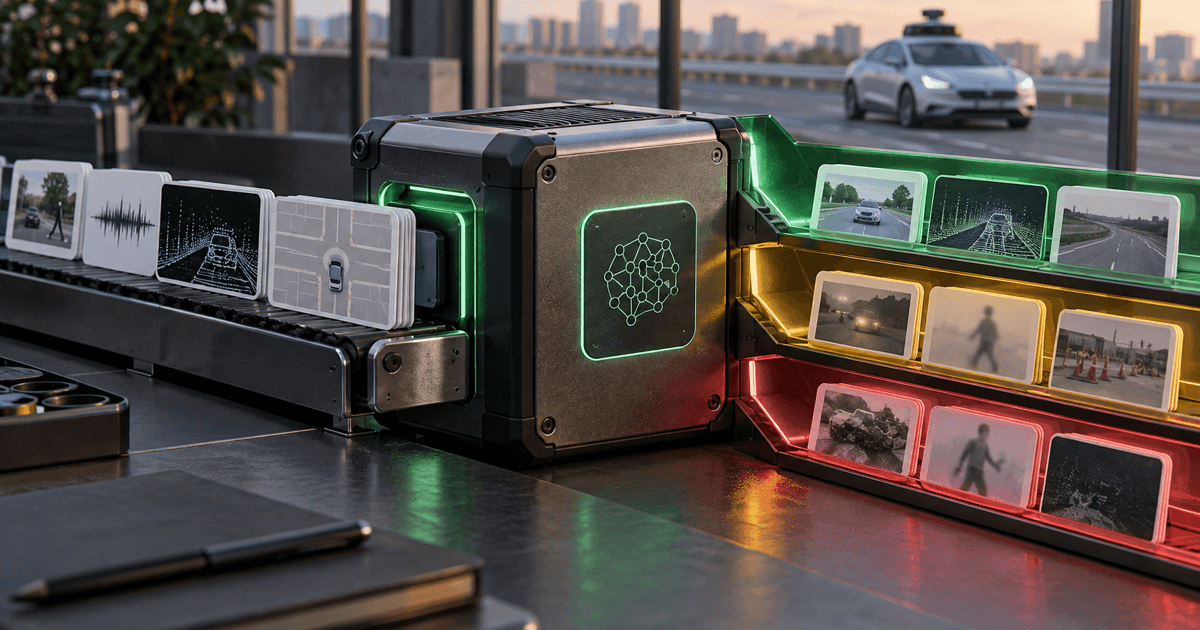
This post translates the safety-evidence moment into copyable AI workflows: video triage, intervention classification, incident evidence packets, claims review, compliance reporting, city-level risk mapping, and model routing. Cost matters because video and sensor review can explode token usage. The winning architecture routes cheap models through routine cases and reserves premium multimodal reasoning for hard, ambiguous, or legally sensitive reviews.
💡 Key Takeaway: Autonomous vehicle safety is becoming an evidence workflow. The teams that win will not just deploy cars; they will build low-cost review systems that convert video, logs, interventions, and claims into trusted operational records.
What changed: from autonomy demos to measured safety evidence
The importance of the IEEE Spectrum report is not just that autonomous cars may be safer in specific operating domains. The market signal is that safety claims are increasingly being backed by structured evidence: disengagements, crash rates, injury reductions, incident video, operational design domain boundaries, and post-event analysis.
That matters because real-world autonomy programs now face four operational pressures at the same time:
- Fleet scale: More miles create more video, sensor logs, and edge cases.
- Regulatory scrutiny: Cities and agencies want proof, not marketing claims.
- Insurance review: Claims teams need incident timelines and liability signals.
- Public trust: Operators must explain what happened before, during, and after an event.
Traditional manual review breaks under this load. A single vehicle can produce hours of forward-facing, cabin, side, and rear video. Add telemetry, planned trajectory, map context, braking events, object detections, remote assistance notes, and customer reports, and each incident becomes a multi-modal evidence problem.
AI models are now good enough to help with the first-pass work: identifying relevant clips, summarizing scenes, extracting traffic actors, classifying interventions, comparing narratives against logs, and creating review packets. The human reviewer still owns final judgment. The model handles the repetitive evidence assembly.
[stat] 1,000,000+ tokens Long-context models now make it practical to review large incident bundles, policy docs, trip logs, and transcripts in one pass when the case justifies premium reasoning.
Six AI safety workflows teams can build now
The practical opportunity is to treat autonomous driving safety as an operations pipeline. These six workflows are useful for different teams, but they share the same pattern: ingest raw evidence, use low-cost models for triage, escalate uncertain cases, and produce structured outputs that humans can audit.
1. Fleet video triage for hard-braking and near-miss events
Fleet operators can start with a simple workflow: detect which clips deserve human review. The trigger can be a hard brake, evasive maneuver, abrupt steering, remote assistance request, collision alert, or passenger complaint.
The AI system reviews short clips and extracts:
- Road type: urban arterial, residential street, highway, parking area
- Weather and visibility
- Traffic density
- Vulnerable road users: pedestrians, cyclists, scooters, emergency vehicles
- Lead-up sequence
- Whether the autonomous system appeared to respond before the human or safety driver
- Whether the event should be escalated
This does not require the most expensive model for every clip. A cheaper vision-capable or multimodal stack can classify routine clips. Premium reasoning should handle ambiguous scenes: occluded pedestrians, unusual construction zones, conflicting signals, or apparent right-of-way disputes.
2. Intervention classification for safety drivers and remote operators
Interventions are one of the most important safety evidence categories. But not all interventions mean the same thing. A safety driver may take over because of a genuine safety risk, a comfort issue, a conservative test protocol, a localization uncertainty, or a planned training scenario.
An AI workflow can classify intervention records into operational categories:
| Intervention type | Evidence needed | Recommended review level |
|---|---|---|
| Collision avoidance | Video, telemetry, object tracks, brake data | Premium model + human |
| Comfort takeover | Video, route, jerk/braking profile | Standard model + sampling |
| Construction or blocked lane | Video, map mismatch, route plan | Standard model + human spot check |
| Remote assistance request | Video, autonomy state, operator notes | Premium for unresolved cases |
| Policy disagreement | Video, road rules, model rationale | Premium model + safety lead |
| Sensor or localization uncertainty | Logs, diagnostics, map data | Engineering review |
The output should not be a vague paragraph. It should be a structured JSON record that includes the classification, confidence, key evidence references, and reviewer notes.
3. Incident evidence packets for insurance and legal review
Insurance teams care less about autonomy hype and more about reconstructing the event. What happened? Who was present? What did the system perceive? When did braking begin? Was there a traffic violation? Was a pedestrian or cyclist involved? Were there environmental conditions that changed risk?
A model-assisted evidence packet can include:
- One-page incident summary
- Timeline with timestamps
- Scene diagram description
- Actor list: vehicle, pedestrian, cyclist, other vehicles, obstacles
- Relevant telemetry excerpts
- Video frame references
- Claims narrative comparison
- Missing evidence checklist
- Escalation recommendation
This workflow is valuable because it creates consistency. Instead of every adjuster or operations analyst manually hunting through clips and logs, the model assembles the same packet structure every time.
4. City transportation safety dashboards
City transportation teams can use AI review to understand patterns across incidents and near misses. The city does not need access to proprietary autonomy internals to get value. It can analyze de-identified event summaries, road context, location, and public infrastructure factors.
Useful outputs include:
- Repeated hard-braking locations
- Unprotected left-turn risk zones
- Crosswalk visibility problems
- Bike lane conflict points
- Construction areas causing autonomy uncertainty
- Signal timing issues
- Emergency vehicle interaction hotspots
This turns autonomous fleet data into infrastructure feedback. A city can compare AV near-miss patterns against human crash data and prioritize street design changes.
5. Compliance evidence generation
Regulators and internal safety boards need standardized evidence. AI can help generate repeatable reports that map incidents and interventions to a company’s safety case, operating domain, internal policy, and reporting requirements.
A compliance workflow can produce:
- Operating domain match or mismatch
- Incident severity classification
- Reportability determination
- Policy section references
- Reviewer assignment
- Evidence completeness score
- Audit trail of model and human decisions
The key is version control. Every report should include the model used, prompt version, evidence hash, reviewer identity, and final human disposition.
6. Premium-model routing for hard cases only
The most important workflow is cost control. Multimodal review gets expensive when teams send every clip and log bundle to the strongest model. A better pattern is three-stage routing:
- Cheap triage model: classify obvious safe, irrelevant, or duplicate clips.
- Standard reasoning model: summarize moderate cases and build draft packets.
- Premium multimodal reasoning model: review ambiguous, high-severity, disputed, or compliance-sensitive cases.
This architecture keeps quality high where it matters and prevents routine events from consuming the budget.
Workflow 1: Build an autonomous driving video triage pipeline
This workflow is for fleet operators, AV startups, delivery robotics teams, and safety operations groups that need to process many short clips every day.
Step 1: Define event triggers
Start with deterministic triggers from the vehicle or fleet platform:
- Hard braking above threshold
- Sudden steering correction
- Manual takeover
- Remote assistance request
- Collision warning
- Passenger report
- Emergency vehicle detection
- Stopped vehicle in lane
- Vulnerable road user proximity
Each trigger should create an event ID with location, vehicle ID, timestamp, route segment, and available evidence.
Step 2: Clip and compress the evidence
Do not send an entire trip to a model. Create a bounded evidence package:
- 20 seconds before trigger
- 10 seconds after trigger
- Front camera plus relevant side camera
- Key telemetry at 10 Hz or sampled down
- Autonomy state transitions
- Object detection labels if available
- Map context and speed limit
For cost control, extract frames at fixed intervals for first-pass triage. Use full video only when the frame-based review flags uncertainty.
Step 3: Run low-cost first-pass classification
Use a cheaper model for the first review pass. For text-heavy logs and metadata, GPT-5 nano costs $0.05 input / $0.40 output per 1M tokens. For long-context general review, Gemini 2.0 Flash is also inexpensive at $0.10 input / $0.40 output per 1M tokens with 1,000,000 context.
Ask the model to return structured output:
{
  "event_type": "hard_brake_near_miss",
  "severity": "medium",
  "actors": ["ego_vehicle", "pedestrian", "vehicle_turning_right"],
  "weather": "clear",
  "visibility": "daylight",
  "escalate": true,
  "reason": "pedestrian partially occluded by parked vehicle",
  "missing_evidence": ["side_camera_right"]
}
Step 4: Escalate hard cases
Escalate when the model detects:
- Vulnerable road user involvement
- Collision or contact
- Ambiguous right of way
- Emergency vehicle interaction
- Conflicting evidence between video and logs
- Low confidence
- Public complaint or insurance claim
- Regulatory reportability
Send these cases to a stronger model such as GPT-5.2, Claude Sonnet 5, Gemini 3 Pro, or a premium option when deep reasoning is required.
Step 5: Human review and feedback loop
The final triage label should be human-approved for escalated cases. Store disagreements between the model and human reviewer. These disagreements become evaluation data for prompt tuning, routing rules, and safety taxonomy updates.
⚠️ Warning: Do not let the model make final liability or safety determinations. Use AI to assemble, classify, and summarize evidence; keep final incident disposition with trained human reviewers.
Workflow 2: Build an insurance incident evidence packet
This workflow is for insurers, claims administrators, mobility operators, and legal teams handling AV-related events.
Step 1: Normalize the claim file
Create a unified case folder with:
- Claim narrative
- Police report or public incident report
- Vehicle logs
- Video clips
- Still frames
- Telemetry summary
- Driver/passenger statements
- Third-party evidence
- Repair estimate
- Prior related events at the same location
Convert long documents to text. Keep original files linked by evidence ID.
Step 2: Generate an event timeline
Use a standard model to generate a timeline with timestamps:
| Timestamp | Evidence source | Event |
|---|---|---|
| T-12s | front camera | Pedestrian visible near curb |
| T-8s | telemetry | Ego vehicle speed 24 mph |
| T-5s | perception log | Object classified as pedestrian |
| T-3s | control log | Deceleration begins |
| T-1s | video | Other vehicle enters crosswalk area |
| T+0s | trigger | Hard braking event |
| T+4s | cabin audio | Passenger comment recorded |
Require the model to cite evidence IDs for every timeline item. No citation, no packet inclusion.
Step 3: Compare narratives against evidence
Ask the model to compare claims against logs and video:
- Which statements are supported?
- Which statements are contradicted?
- Which statements require more evidence?
- Which timestamps are uncertain?
- Which actors are unidentified?
This is where long-context models help. A claim file can include multiple reports and transcripts. GPT-5 has 1,000,000 context at $1.25 input / $10 output per 1M tokens, making it a strong default for structured claim reasoning. For very large bundles, Gemini 3 Pro offers 2,000,000 context at $2 input / $12 output per 1M tokens.
Step 4: Create the packet
The final packet should include:
- Executive summary
- Event timeline
- Evidence inventory
- Actor table
- Damage and injury summary
- Autonomy system behavior summary
- Contradictions and uncertainties
- Missing evidence request list
- Recommended human review path
Step 5: Route to specialists
Use packet metadata to route the case:
- Low severity, clear evidence: standard adjuster
- Injury, vulnerable road user, disputed facts: senior adjuster
- Regulatory reportability: compliance counsel
- Potential system failure: safety engineering
- Media-sensitive incident: executive review
This saves time because specialists receive a complete packet instead of a raw evidence dump.
Model Choice and Cost
AI safety evidence workflows can be cheap or expensive depending on routing. The mistake is sending every frame, transcript, and log bundle to a premium model. The correct design uses cheaper models for extraction and classification, then escalates the top 5-20% of cases.
Here are useful model options from current AI Cost Check pricing.
| Model | Input / output price per 1M tokens | Context | Best role in safety workflow |
|---|---|---|---|
| GPT-5 nano | $0.05 / $0.40 | 128K | Cheap metadata triage, labels, routing |
| Gemini 2.0 Flash | $0.10 / $0.40 | 1M | Low-cost long-context summaries |
| GPT-5 mini | $0.25 / $2.00 | 500K | Standard incident summaries |
| DeepSeek V4 Flash | $0.14 / $0.28 | 1M | Budget log analysis and batch classification |
| GPT-5 | $1.25 / $10.00 | 1M | Default serious reasoning and evidence packets |
| Claude Sonnet 5 | $2.00 / $10.00 | 1M | Careful narrative review and compliance summaries |
| Gemini 3 Pro | $2.00 / $12.00 | 2M | Very large case bundles and long context |
| GPT-5.2 pro | $21.00 / $168.00 | 1M | Rare, high-stakes expert review |
Cost estimate: video triage
Assume each event uses extracted frames, metadata, and logs totaling 20,000 input tokens and produces 1,000 output tokens.
| Model | Cost per event | Cost per 1,000 events |
|---|---|---|
| GPT-5 nano | $0.0014 | $1.40 |
| Gemini 2.0 Flash | $0.0024 | $2.40 |
| GPT-5 mini | $0.0070 | $7.00 |
| GPT-5 | $0.0350 | $35.00 |
| Claude Sonnet 5 | $0.0500 | $50.00 |
| GPT-5.2 pro | $0.5880 | $588.00 |
For first-pass triage, premium models are overkill. Use GPT-5 nano, Gemini 2.0 Flash, DeepSeek V4 Flash, or GPT-5 mini. Save GPT-5, Claude Sonnet 5, Gemini 3 Pro, or GPT-5.2 pro for escalations.
Cost estimate: full incident evidence packet
Assume each serious incident includes 150,000 input tokens across logs, reports, transcripts, and frame descriptions, plus 8,000 output tokens for a structured packet.
| Model | Cost per packet | Cost per 1,000 packets |
|---|---|---|
| DeepSeek V4 Flash | $0.0232 | $23.24 |
| Gemini 2.0 Flash | $0.0182 | $18.20 |
| GPT-5 mini | $0.0535 | $53.50 |
| GPT-5 | $0.2675 | $267.50 |
| Claude Sonnet 5 | $0.3800 | $380.00 |
| Gemini 3 Pro | $0.3960 | $396.00 |
| GPT-5.2 pro | $4.4940 | $4,494.00 |
Premium review is justified for serious injury, disputed liability, regulatory escalation, or unexplained system behavior. It is wasteful for routine hard brakes, duplicate clips, and low-severity comfort interventions.
📊 Quick Math: If a fleet reviews 100,000 events/month, first-pass triage on GPT-5 nano is roughly $140/month under the 20K input + 1K output assumption. Running every event through GPT-5.2 pro would be about $58,800/month for the same token volume.
For broader model tradeoffs, compare GPT-5 vs Gemini 3 Pro, GPT-5 vs DeepSeek V3.2, or use AI Cost Check to plug in your own token volumes.
Recommended architecture for safety evidence operations
A reliable AV evidence stack needs more than a single model call. It should be designed like an audit system.
Ingestion layer
Collect event data from vehicles, mobile apps, claims systems, and public reports. Normalize every artifact into a case ID. Store raw video separately from extracted frame sets and model-readable summaries.
Evidence index
Create a searchable evidence index with:
- Event ID
- Vehicle ID
- Location
- Time
- Trigger type
- Clip references
- Telemetry references
- Human notes
- Model outputs
- Final disposition
Use embeddings for search, but do not rely on embedding similarity for final safety decisions. Embeddings are useful for finding similar events, not for proving what happened.
Model routing layer
Define routing rules before deployment:
| Condition | Route |
|---|---|
| Clear duplicate or irrelevant event | Cheap triage model |
| Routine hard brake, no vulnerable road user | Standard summary model |
| Vulnerable road user present | Premium review + human |
| Conflicting logs and video | Premium review + engineering |
| Injury or property damage | Evidence packet + senior reviewer |
| Regulatory reportability | Compliance workflow |
| Low model confidence | Human queue |
Human review console
Reviewers need side-by-side evidence, not just model summaries. Show the model output next to video frames, telemetry graphs, maps, and source citations. Allow reviewers to correct labels quickly.
Audit log
Every model output should record:
- Model name
- Prompt version
- Input evidence IDs
- Timestamp
- Output JSON
- Confidence score
- Human reviewer action
- Final disposition
This is what turns AI assistance into defensible operations.
✅ TL;DR: Use AI to standardize evidence assembly, triage, and summarization. Use humans for final safety, liability, compliance, and engineering decisions. Route expensive models only to cases where ambiguity or severity requires them.
Risks, limits, and when not to use AI review
AI review is useful, but safety operations cannot tolerate unsupported claims. The biggest risk is treating model output as ground truth. It is not. It is a structured assistant that can miss context, overstate confidence, misread visual scenes, or summarize logs incorrectly.
Do not use AI as the final authority for:
- Liability decisions
- Regulatory reportability
- Root-cause determination
- Safety driver performance discipline
- Public incident statements
- Engineering release approvals
- Severe injury or fatality conclusions
Use AI aggressively for:
- Evidence collection
- Clip prioritization
- Timeline drafts
- Missing evidence detection
- Similar incident search
- Report formatting
- Human reviewer preparation
The second risk is privacy. Driving video can include faces, license plates, homes, children, medical events, and sensitive locations. Redaction and retention policies must be designed before model review starts.
The third risk is benchmark mismatch. A model that performs well on general video understanding may still fail on rare traffic-control edge cases. Build your own evaluation set from historical incidents, near misses, construction scenes, emergency vehicle interactions, and weather events.
The fourth risk is cost creep. Teams start with short clips, then add full trips, multiple cameras, transcripts, maps, and logs. Token volume grows quietly. Put hard limits on evidence size by workflow type and require escalation approval for premium model runs.
Practical prompts and output schemas
A good safety prompt is narrow, evidence-bound, and structured. Avoid asking for broad opinions about fault or safety. Ask for observable facts and uncertainty.
Video triage prompt
Use this for frame-based review and short incident clips:
You are assisting a fleet safety reviewer. Analyze only the provided evidence.
Return structured JSON. Do not determine legal fault.

Classify the event using:
- event_type
- severity: low, medium, high
- road_context
- weather_visibility
- actors_present
- vulnerable_road_users_present
- autonomy_response_observed
- escalation_required
- escalation_reason
- missing_evidence
- confidence

Cite evidence IDs for every important observation.
Claims evidence prompt
Use this for insurance packet generation:
You are preparing a draft incident evidence packet for a human claims reviewer.
Use only the provided claim documents, telemetry summaries, video frame descriptions, and reports.
Do not assign legal liability.

Produce:
1. Executive summary
2. Timeline with timestamps and evidence IDs
3. Actor table
4. Supported claim statements
5. Contradicted claim statements
6. Unknowns and missing evidence
7. Recommended reviewer route
8. Compliance or injury flags
Compliance review prompt
Use this for internal safety boards:
Map this incident to the provided safety taxonomy and reporting policy.
Return JSON with:
- operating_domain_match
- severity_class
- reportability_candidate
- policy_sections
- evidence_completeness_score
- unresolved_questions
- required_human_roles
- final_note_for_reviewer

If evidence is insufficient, say insufficient evidence and list what is missing.
These prompts work best when paired with deterministic post-processing. If the model says “high severity,” your system should require evidence IDs, a human reviewer, and a case status change.
Who should build what first?
Different teams should prioritize different workflows.
Fleet operators
Start with video triage and intervention classification. These produce immediate savings because they reduce manual review volume. Use cheap routing for all events, then escalate the small set of high-severity and uncertain cases.
Insurance teams
Start with incident evidence packets. The value is consistency, faster claim handling, and better identification of missing evidence. Use standard models for draft packets and premium models for disputed or severe claims.
Mobility startups
Start with compliance evidence generation and audit logs. Early-stage teams need investor, regulator, partner, and city confidence. A clean evidence system is a market advantage.
City transportation teams
Start with aggregated safety pattern analysis. Ask operators for de-identified event summaries, not proprietary autonomy internals. Use the data to identify infrastructure changes that reduce risk for all road users.
Safety engineering teams
Start with similar-incident search and root-cause preparation. AI can cluster repeated edge cases and assemble evidence for engineers, but humans should own root cause.
Frequently asked questions
What did the IEEE Spectrum autonomous car safety report change?
It reinforces that autonomous vehicle safety is becoming a measurable operations discipline rather than a pure hype cycle. Teams now need evidence workflows that can review video, logs, interventions, claims, and compliance records at scale.
How much does AI review of autonomous driving events cost?
A light triage review using 20,000 input tokens and 1,000 output tokens can cost about $0.0014 per event on GPT-5 nano, or $1.40 per 1,000 events. A fuller incident packet with 150,000 input tokens and 8,000 output tokens costs about $0.2675 on GPT-5. Use AI Cost Check to model your own evidence size.
Which model should fleet operators use for video and incident triage?
Use a cheap model such as GPT-5 nano, Gemini 2.0 Flash, DeepSeek V4 Flash, or GPT-5 mini for first-pass triage. Route ambiguous, severe, disputed, or compliance-sensitive events to GPT-5, Claude Sonnet 5, Gemini 3 Pro, or a premium model.
Can AI decide fault in an autonomous vehicle accident?
No. AI should not make final legal fault, liability, regulatory, or safety determinations. It should assemble evidence, draft timelines, identify contradictions, classify event types, and prepare human reviewers.
What is the best first workflow for an AV safety team?
Start with intervention classification. It is high-volume, operationally important, and easy to structure. Classify each intervention by trigger, road context, severity, vulnerable road user presence, escalation need, and evidence completeness.
CTA: build the evidence workflow before the next incident
Autonomous systems are moving into a phase where safety claims must be proven with repeatable evidence. The teams that build disciplined AI review pipelines now will process incidents faster, find edge cases earlier, and control review costs as fleet miles grow.
Start by estimating your event volume and token budget in AI Cost Check. Then compare likely model stacks such as GPT-5 vs Gemini 3 Pro, GPT-5 vs DeepSeek V3.2, and GPT-5 vs GPT-5 mini. For model-specific planning, review GPT-5, Gemini 3 Pro, Claude Sonnet 5, and GPT-5 nano.
The practical next step: pick one workflow, define the evidence schema, run 100 historical events through a cheap triage model, and measure agreement with human reviewers before scaling.
Related Cost Guides
Keep going with the closest pricing and optimization guides in this cluster.
OpenAI Research Acceleration Workflows: Turn Papers, Evals, and Logs Into AI Roadmaps
Build AI research acceleration workflows that convert papers, evals, and experiment logs into production-ready roadmaps.
Pion and the Autonomous-Company Agent: 7 Workflows Founders Can Delegate Now
Andon Labs' Pion shows how autonomous-company agents can run business workflows with approval gates, tools, and cost controls.
What Fable 5.1 Cracking a 370-Year Cipher Means for Research Workflows
How frontier reasoning models can power archival research, evidence review, cipher analysis, and auditable investigation workflows.