Need exact pricing after reading? Jump straight to the AI API pricing table, the AI cost estimator, or the AI model cost comparison to price the workflow in this article with your own traffic and token counts.
Compare per-token prices across OpenAI, Claude, Gemini, DeepSeek, Mistral, and more.
Turn token counts and request volume into cost per request, daily spend, and monthly spend.
See which model is cheaper for the exact workload this article is talking about.
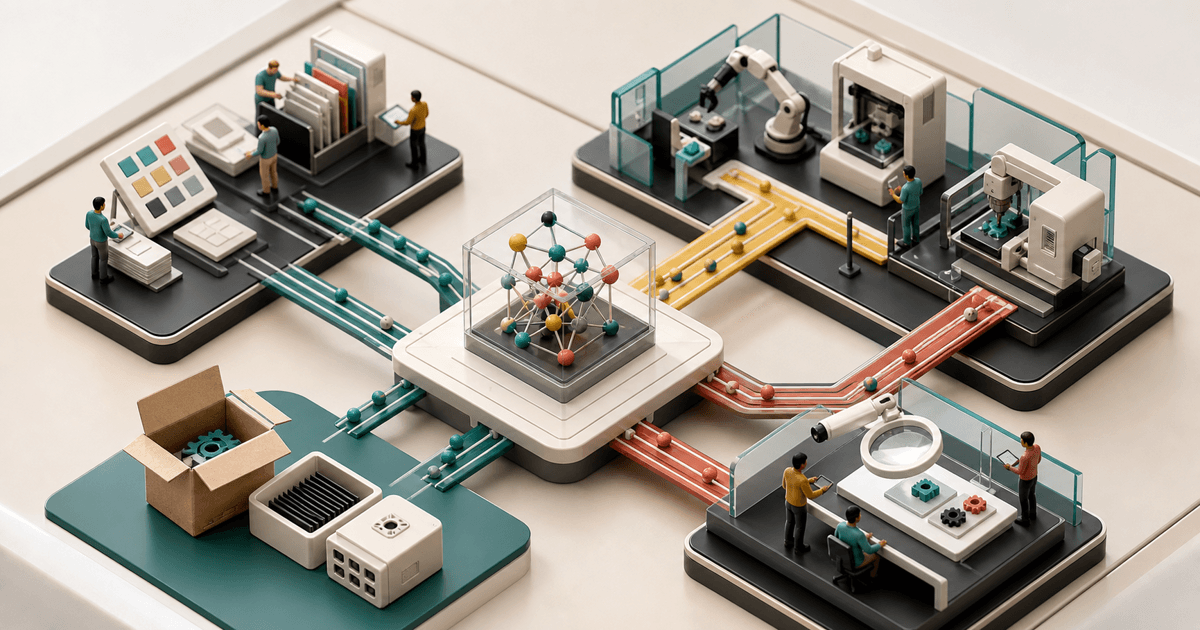
Anthropic opened a research preview of the Model Hardware Standard on August 27, 2026, and the important part is not another connector spec. The market-moving idea is model-agnostic AI control over real hardware: lab instruments, robotic workcells, factory stations, test benches, environmental chambers, conveyors, microscopy rigs, liquid handlers, CNC-adjacent inspection tools, and edge devices that need careful orchestration.
For founders, lab operations teams, and advanced manufacturing leaders, MHS matters because the bottleneck in physical AI workflows is no longer only model intelligence. It is the messy handoff between AI reasoning and hardware action: device APIs, safety interlocks, vendor-specific command layers, logs, calibration metadata, failure modes, audit trails, and recovery plans. A standard interface gives teams a way to build one AI operations layer that can work across multiple models and multiple hardware stacks.
This post breaks down what MHS is, why model-agnostic hardware control matters now, and the practical workflows teams can copy first: autonomous assay optimization, round-the-clock equipment monitoring, robotic handoffs, fault recovery, factory calibration, instrument documentation agents, and human-in-the-loop approval systems. Cost is not the headline, but it determines architecture: premium frontier models should handle planning, anomaly reasoning, protocol critique, and high-risk recovery; cheaper models should handle telemetry summarization, routing, routine classification, and repetitive status checks.
💡 Key Takeaway: MHS is best understood as an AI-to-hardware control layer, not a single robot product. The near-term opportunity is to standardize how AI agents observe equipment state, choose safe actions, call hardware tools, and produce auditable logs across labs and factories.
What changed with Anthropic’s Model Hardware Standard preview
The research preview signals that Anthropic wants AI models to interact with physical hardware through a more explicit, structured, and interoperable layer. Instead of every AI agent team writing custom glue code for each liquid handler, robotic arm, microscope, PLC-adjacent device, incubator, spectrometer, test fixture, or inspection station, MHS points toward a common way to describe hardware capabilities, constraints, commands, state, and results.
That shift matters because hardware automation is full of edge cases. A model cannot simply “run the assay” or “calibrate the line.” It needs to know what hardware exists, what each machine can do, which commands are allowed, what state the device is in, what safety envelope applies, what sensor readings matter, and what to do when a command partially succeeds. In software-only agent workflows, a failed tool call might waste tokens. In hardware workflows, a bad action can destroy samples, damage equipment, create downtime, or trigger safety incidents.
MHS is important because it gives teams a design target for agentic hardware systems:
| MHS design area | What it standardizes | Why teams care |
|---|---|---|
| Device capability description | What a device can do, accepted parameters, limits | Reduces custom wrappers per instrument |
| Hardware state reporting | Current status, readiness, errors, sensor values | Lets agents reason before acting |
| Tool invocation | Structured commands with validation | Prevents ambiguous free-text control |
| Safety constraints | Allowed operations, blocked states, human approval gates | Reduces physical-world risk |
| Observability | Logs, action traces, measurements, timestamps | Makes audits and root-cause analysis easier |
| Model portability | Same hardware layer usable by multiple models | Avoids lock-in to one frontier provider |
The immediate market pull is strongest in biology, chemistry, materials science, semiconductor operations, high-mix manufacturing, robotics integrators, contract labs, and production teams with expensive equipment sitting idle outside staffed hours. These teams already have automation hardware. What they lack is a reliable AI coordination layer that can read intent, reason through constraints, sequence tools, monitor outcomes, and escalate when necessary.
Why model-agnostic AI-to-hardware control matters now
The last two years of AI deployment taught operators a hard lesson: the best model for planning is rarely the cheapest model for monitoring. A lab agent may need a premium model to redesign an assay after unexpected readings, but it does not need that same model to summarize incubator telemetry every five minutes. A factory calibration agent may need advanced reasoning when a sensor drift pattern conflicts with prior maintenance logs, but routine pass/fail classification can run on a low-cost model.
Model-agnostic hardware control separates the hardware interface from the model choice. That is the architectural unlock. If the hardware layer is standardized, teams can route different tasks to different models without rewriting device integrations every quarter.
This matters now for four reasons.
First, context windows are large enough to ingest protocols, equipment manuals, historical logs, and batch records. Models like GPT-5.2, Claude Opus 5, Claude Sonnet 5, and Gemini 3 Pro can process long operational histories that were impractical to include in earlier agent loops.
Second, frontier models are now good enough at multi-step planning to handle complex constraints. Hardware workflows require more than chat. The agent must respect timing windows, physical ordering, safety checks, device readiness, inventory, environmental conditions, and measurement quality.
Third, hardware teams need vendor flexibility. Lab and factory equipment is a long-lived asset class. Teams cannot rebuild their AI layer every time they switch from one robotic arm to another, add a new instrument vendor, or route a task from Claude to Gemini for budget reasons.
Fourth, cost pressure is forcing routing. A hardware workflow can generate millions of telemetry tokens per month. Premium models are justified for decision points, not every sensor event.
[stat] 10x to 60x The common API price spread between cheap monitoring models and premium frontier reasoning models for hardware-agent workloads
7 practical workflows teams can build with MHS
MHS is early, so teams should not treat it as a plug-and-play replacement for validated automation software. The right approach is to use the research preview as a blueprint for building structured, auditable AI-to-hardware systems. Start where the upside is high and the action space can be constrained.
1. Autonomous assay optimization
Autonomous assay optimization is the clearest early lab use case. The agent proposes experimental changes, executes bounded parameter sweeps through connected instruments, monitors results, and updates the next run. A human scientist defines the objective function and guardrails; the agent explores within them.
Example workflow:
- Read the assay protocol, plate map, inventory, instrument readiness, and historical results.
- Propose a small batch of parameter changes: concentration, incubation time, temperature, wash cycles, reagent ratios.
- Validate each proposed run against allowed bounds.
- Execute liquid handling, incubation, measurement, and data capture through MHS-style device commands.
- Analyze results and choose the next batch.
- Escalate when results violate quality thresholds or when the model wants to leave the approved search space.
This workflow is especially valuable for biotech startups, assay development groups, synthetic biology teams, and materials labs where optimization cycles are expensive because they require staff attention across multiple instruments.
2. Round-the-clock equipment monitoring
Many labs and factories already collect status data, but humans still perform too much interpretation. An MHS-aware monitoring agent can watch equipment telemetry, logs, environmental readings, run status, and maintenance events continuously. The agent should not control high-risk actions by default. It should classify issues, summarize state, open tickets, and trigger safe automated responses.
For example, an incubator drift event might start as a cheap-model classification task. If the pattern matches known benign behavior, the agent logs it. If it threatens an active experiment, a stronger model receives the relevant context: experiment metadata, recent interventions, equipment manual excerpts, previous drift episodes, and permitted recovery actions.
3. Robotic handoffs between instruments
High-value automation often fails at handoffs. A robotic arm moves a plate from a liquid handler to an incubator, then to a reader, then to storage. Each step has state dependencies: door open, gripper ready, plate orientation confirmed, destination clear, device idle, barcode matched, environment acceptable.
MHS can provide a common control vocabulary for these handoffs. The model sees available devices, current states, and allowed commands, then plans the next safe movement. This reduces brittle script logic and enables more adaptive scheduling when one instrument runs late or a plate fails a barcode scan.
4. Fault recovery after partial failures
Hardware workflows fail in ugly ways: a pipette tip clogs, a gripper misaligns, a sensor times out, an imaging run produces low-confidence focus, a motor hits a limit, a barcode is unreadable, or an instrument returns a vendor-specific error code. Today, many automation systems stop and wait for a human.
An AI fault recovery agent can turn error handling into a structured decision process. It can inspect logs, compare the current state to expected state, decide whether a safe retry is allowed, and escalate with a concise recovery brief. The model should not improvise unrestricted physical actions. It should choose from approved recovery playbooks.
5. Factory calibration and inspection loops
Advanced manufacturing teams can use an MHS-like pattern to calibrate stations, validate fixtures, and respond to inspection drift. The agent reads measurements from sensors, cameras, gauges, or test benches; compares them against tolerances; adjusts allowed parameters; and records the result.
Good first targets include:
- Camera alignment calibration
- Sensor zeroing workflows
- Torque test validation
- Environmental chamber qualification
- End-of-line inspection threshold tuning
- Fixture wear monitoring
- Multi-station drift comparison
This is not a replacement for industrial safety systems or PLC control. It is a reasoning and coordination layer above constrained, validated controls.
6. Instrument documentation and runbook agents
The least risky early workflow is documentation. The agent reads equipment manuals, SOPs, change logs, and maintenance records, then answers operator questions or generates step-by-step runbooks for approved procedures. It can also translate vendor error codes into likely causes and recommended next steps.
This is where cheaper models are often enough. Use premium models only when the answer requires cross-document reasoning across complex protocols, maintenance history, and live telemetry.
7. Human approval gates for physical automation
The most deployable MHS pattern is not full autonomy. It is structured autonomy with human approval at key points. The agent plans a hardware action, validates it against constraints, explains risk, estimates expected outcome, and asks for approval before execution.
This pattern works well for regulated labs, pilot manufacturing lines, and teams still building trust. The system can move from “recommend only” to “execute low-risk actions” as validation data accumulates.
⚠️ Warning: Do not let a general-purpose model issue free-form hardware commands directly. Use a constrained tool layer, typed parameters, device-state checks, simulation or dry-run mode, and explicit human approval for actions that can damage samples, equipment, or production output.
Step-by-step workflow: autonomous assay optimization
This is the workflow most likely to attract biotech founders and lab automation teams because it converts AI reasoning into faster experimental cycles. The key is to keep the agent’s search space narrow enough to validate.
Step 1: Define the optimization objective
Start with one measurable objective, not a vague instruction. Examples:
- Maximize fluorescence signal while keeping coefficient of variation below 10%
- Minimize background signal while preserving positive control response
- Improve yield by 15% without increasing incubation time
- Reduce reagent use by 20% while maintaining assay Z-factor
The objective should include hard constraints. The agent can optimize only within approved ranges.
Step 2: Build the hardware capability map
Represent each device in a structured schema:
| Device | Capabilities | Agent-visible state | Restricted actions |
|---|---|---|---|
| Liquid handler | Dispense, aspirate, mix, transfer | Deck layout, tips, reagents, errors | No custom volumes outside validated range |
| Plate reader | Read absorbance/fluorescence | Loaded plate, method, status | No unapproved wavelength changes |
| Incubator | Set temperature, load/unload | Temperature, humidity, occupancy | No temperature changes during active run |
| Robotic arm | Move plate, scan barcode | Gripper state, position, errors | No movement without clear destination |
This map is the practical version of what MHS makes valuable: the model sees capabilities and constraints instead of raw device APIs.
Step 3: Create a bounded experiment planner
The planner should output a structured batch proposal:
{
  "objective": "maximize signal with CV < 10%",
  "proposed_runs": [
    {
      "well_group": "B1:B12",
      "parameter_changes": {
        "incubation_minutes": 35,
        "reagent_a_ul": 8,
        "wash_cycles": 3
      },
      "rationale": "Tests lower reagent volume while preserving wash stringency."
    }
  ],
  "risk_level": "low",
  "requires_human_approval": true
}
Use a premium model for this planning step when the assay is complex. Claude Opus 5, GPT-5.2 pro, or GPT-5.6 Sol are better fits for reasoning-heavy design decisions than cheap monitoring models.
Step 4: Validate before execution
Run deterministic validation before any hardware command:
- Are volumes within allowed bounds?
- Are reagents available?
- Is the plate map valid?
- Are controls included?
- Is the incubator free?
- Is the reader method approved?
- Does the plan require human approval?
The model proposes; your validator decides whether the proposal can proceed.
Step 5: Execute through constrained tools
The execution layer should call typed functions such as:
load_plate(source, destination)dispense_reagent(reagent_id, volume_ul, wells)start_incubation(plate_id, minutes, temperature_c)run_plate_read(method_id, plate_id)export_measurements(run_id)
The model should never send arbitrary device commands. It should select from safe operations.
Step 6: Analyze results and choose the next batch
After measurements return, route analysis based on complexity. A cheap model can summarize results and detect threshold violations. A premium model should decide the next experimental batch when the result pattern is surprising or when tradeoffs are non-obvious.
Step 7: Log every decision
For each run, store:
- Prompt context
- Model used
- Proposed plan
- Validator result
- Hardware commands issued
- Measurement outputs
- Human approvals
- Errors and recovery actions
In regulated environments, this audit trail is not optional. It is the difference between an impressive demo and a deployable system.
✅ TL;DR: The copyable pattern is “premium model plans, deterministic validator approves, constrained hardware tools execute, cheap model monitors, premium model re-enters for interpretation or recovery.”
Step-by-step workflow: factory calibration agent
Manufacturing teams should start with calibration and inspection workflows because the action space is easier to constrain than full production control. The agent’s job is to detect drift, recommend or perform approved adjustments, and document outcomes.
Step 1: Pick one measurable station
Do not start with the whole line. Choose one station with clear inputs and outputs:
- Vision inspection camera
- Force or torque test station
- Dimensional measurement fixture
- Temperature-controlled process step
- End-of-line electrical test bench
The station should already have digital logs or sensor outputs. MHS-style AI control works best when the system can observe state reliably.
Step 2: Define pass/fail and adjustment boundaries
Create hard rules:
- Calibration target: ±0.2 mm
- Maximum adjustment per cycle: 0.05 mm
- Maximum attempts: 3
- Required confirmation sample count: 10
- Escalation threshold: any two failed attempts or anomalous sensor reading
The model is allowed to reason within these boundaries. It is not allowed to invent new tolerances.
Step 3: Build the station state object
A station state object should include:
{
  "station_id": "vision-cell-03",
  "current_status": "idle",
  "last_calibration": "2026-09-02T08:15:00Z",
  "measurement_drift_mm": 0.16,
  "camera_temperature_c": 42.1,
  "fixture_cycles": 18420,
  "recent_fail_rate": 0.037,
  "allowed_actions": [
    "run_check_sample",
    "adjust_camera_offset",
    "capture_reference_image",
    "open_maintenance_ticket"
  ]
}
This mirrors the MHS idea: the model receives structured state and a list of safe commands.
Step 4: Run cheap monitoring continuously
A lower-cost model can classify station status every few minutes:
- Normal
- Watch
- Calibration recommended
- Escalate
- Stop and notify
Models such as GPT-5 nano, Gemini 2.5 Flash-Lite, DeepSeek V4 Flash, or Mistral Small 4 are well suited for routine summarization and classification.
Step 5: Route drift events to a stronger model
When drift exceeds a threshold, route a compact packet to a stronger model:
- Last 24 hours of measurements
- Last calibration settings
- Fixture age
- Environmental conditions
- Maintenance history
- Approved adjustment playbook
- Current production priority
Use a premium model when the situation involves conflicting evidence, repeated failures, or potential downtime.
Step 6: Execute approved calibration steps
The agent should produce a structured action plan:
- Run reference sample.
- Compare measurement error to target.
- Apply offset within maximum adjustment.
- Run 10 confirmation samples.
- Record before/after results.
- Escalate if failure persists.
If the station touches safety-critical output, keep a human approval gate before applying changes.
Step 7: Record ROI and downtime impact
Track the business result:
- Reduced manual calibration minutes
- Fewer false rejects
- Lower scrap rate
- Shorter mean time to recovery
- Improved overnight utilization
This is how hardware AI projects survive budget review. The winning metric is not “AI autonomy.” It is fewer stopped lines, fewer failed runs, and better asset utilization.
Model Choice and Cost
MHS-style workflows should use a routed model stack. Premium frontier models are worth paying for when the agent must interpret ambiguous evidence, plan multi-step physical work, resolve conflicting constraints, or write a recovery brief that a human will trust. They are overkill for heartbeat checks, telemetry summaries, routine classifications, and simple runbook lookup.
Here is a practical model selection table using current AI Cost Check pricing data.
| Model | Price per 1M input / output tokens | Context | Best role in MHS workflows |
|---|---|---|---|
| Claude Opus 5 | $5 / $25 | 1,000,000 | Premium lab planning, ambiguous fault recovery, protocol critique |
| Claude Sonnet 5 | $2 / $10 | 1,000,000 | Strong default for hardware agents with better cost control |
| GPT-5.2 | $1.75 / $14 | 1,000,000 | Long-context operations reasoning and structured planning |
| Gemini 3 Pro | $2 / $12 | 2,000,000 | Long manuals, logs, and cross-document hardware reasoning |
| GPT-5 mini | $0.25 / $2 | 500,000 | Mid-cost fallback for routine planning and operator copilots |
| DeepSeek V4 Flash | $0.14 / $0.28 | 1,000,000 | Low-cost monitoring, classification, status summaries |
| Gemini 2.5 Flash-Lite | $0.1 / $0.4 | 1,000,000 | Cheap telemetry summarization and document Q&A |
| Mistral Small 4 | $0.15 / $0.6 | 128,000 | Lightweight local-style operational assistants |
For a concrete estimate, assume one assay optimization run uses:
- 80,000 input tokens for protocol, recent results, equipment state, and constraints
- 8,000 output tokens for plan, rationale, validation notes, and run summary
Approximate per-run API cost:
| Model | Estimated cost per assay-planning run | Cost per 1,000 runs |
|---|---|---|
| Claude Opus 5 | $0.60 | $600 |
| Claude Sonnet 5 | $0.24 | $240 |
| GPT-5.2 | $0.25 | $252 |
| Gemini 3 Pro | $0.26 | $256 |
| GPT-5 mini | $0.036 | $36 |
| DeepSeek V4 Flash | $0.013 | $13.44 |
The cost gap is real, but it should not push teams into using cheap models for high-risk decisions. A failed assay run can cost more than 1,000 premium model calls. A stopped production station can cost more than a month of routed AI usage.
For continuous monitoring, assume a station or instrument generates a summarized check every 5 minutes, or 288 checks per day. If each check uses 3,000 input tokens and 300 output tokens, monthly usage is about 25.9M input tokens and 2.6M output tokens per monitored asset.
Approximate monthly cost per asset:
| Model | Monthly monitoring cost per asset |
|---|---|
| DeepSeek V4 Flash | $4.35 |
| Gemini 2.5 Flash-Lite | $3.63 |
| GPT-5 nano | $2.33 |
| GPT-5 mini | $11.66 |
| Claude Sonnet 5 | $77.76 |
| Claude Opus 5 | $194.40 |
This is why routing is mandatory. Use cheap models for the 288 daily checks. Escalate only the 1-5% of events that need deeper reasoning.
📊 Quick Math: If a monitored instrument creates 288 daily checks, routing 98% to a $3-$5/month lightweight model and 2% to a premium model keeps monthly cost near single digits to low tens per asset, while preserving frontier reasoning for dangerous or expensive exceptions.
For your own token mix, run scenarios in AI Cost Check. If you are comparing frontier defaults, start with GPT-5 vs Claude Opus 4.6, GPT-5 vs Gemini 3 Pro, and Claude Opus 4.6 vs DeepSeek V3.2 to see how premium and fallback economics diverge.
Recommended stack for MHS-style hardware agents
A production-grade AI-to-hardware stack needs more than a model and a device driver. The right architecture has five layers.
1. Hardware abstraction layer
This is where MHS should live conceptually. Every device should expose:
- Capabilities
- Required parameters
- Current state
- Safety limits
- Error codes
- Command results
- Maintenance metadata
The agent should never call vendor APIs directly. Wrap hardware in a typed interface that validates all commands.
2. Policy and safety layer
Create a rules engine outside the model. It should enforce:
- Approved parameter ranges
- Required human approvals
- Device lockouts
- Sample protection rules
- Production safety constraints
- Maximum retry counts
- Escalation conditions
Models are probabilistic. Safety policy should be deterministic.
3. Model router
The router decides which model handles each task:
| Task type | Recommended model tier |
|---|---|
| Telemetry summary | Cheap fallback |
| Routine classification | Cheap fallback |
| SOP lookup | Cheap or mid-tier |
| Experiment planning | Premium or strong mid-tier |
| Fault recovery | Premium |
| Human approval brief | Premium or strong mid-tier |
| Long manual synthesis | Long-context premium or pro-tier |
The router is one of the biggest cost levers in physical AI operations.
4. Simulator or dry-run mode
Before execution, run the proposed hardware plan in simulation. At minimum, simulate:
- Device availability
- Deck layout
- Plate locations
- Timing conflicts
- Inventory use
- Collision or access conflicts
- Invalid command sequences
A dry run catches errors before they become physical failures.
5. Audit and observability layer
Log both model and hardware events in one timeline. Operators need to answer:
- What did the model know?
- What did it propose?
- Which validator approved it?
- Which hardware command executed?
- What changed physically?
- What measurement came back?
- Who approved exceptions?
Without unified logs, root-cause analysis becomes guesswork.
Risks, limits, and when not to use MHS-style autonomy
MHS-style AI-to-hardware control is powerful, but the first deployments should be conservative. The biggest risk is treating model intelligence as a substitute for process validation. It is not.
Do not use autonomous model control when the hardware action can create immediate safety hazards, violate regulatory requirements, damage expensive equipment, or alter production output without validated controls. For those environments, start with monitoring, documentation, recommendation, and human-approved execution.
The second risk is hidden state. Models can only reason over the state they receive. If the system does not know that a plate was manually moved, a reagent bottle is mislabeled, a gripper was swapped, or a fixture is worn beyond tolerance, the model may produce a plausible but unsafe plan. Hardware state needs to be machine-readable and current.
The third risk is vendor-specific behavior. Even with a standard interface, devices behave differently under load, after errors, and during recovery. Build test suites around real failure modes, not only happy-path demos.
The fourth risk is cost drift. Hardware agents can become expensive when teams send full logs, manuals, and histories to premium models on every loop. Summarize aggressively, cache stable context, use retrieval, and escalate selectively.
The fifth risk is unclear accountability. In labs and factories, someone must own the approved action space. The model is not the process owner. Assign responsibility to lab ops, manufacturing engineering, quality, or automation engineering before expanding autonomy.
⚠️ Warning: The safest first deployment is not “AI controls the lab overnight.” It is “AI monitors overnight, drafts recovery options, executes only pre-approved low-risk actions, and escalates with complete context when confidence or authority is insufficient.”
Deployment roadmap: from preview to production
Teams should treat the MHS research preview as a planning signal and build incrementally. A practical 90-day roadmap looks like this.
Days 1-15: Inventory and workflow selection
Pick one workflow with measurable ROI. Good candidates include plate-reader run summaries, incubator anomaly monitoring, robot handoff validation, calibration drift detection, or instrument error-code triage.
Document:
- Devices involved
- APIs or control interfaces
- Safety constraints
- Data streams
- Human approval points
- Failure modes
- Cost of downtime or failed runs
Days 16-30: Create device schemas and state objects
Build structured representations for each device. Include capabilities, state, and constraints. Keep schemas small enough for models to reason over but complete enough to prevent unsafe assumptions.
Days 31-45: Build read-only copilots
Start with read-only use cases:
- Summarize run status
- Interpret logs
- Draft shift handoff notes
- Explain alerts
- Recommend next actions
- Generate maintenance tickets
This gives operators value without physical control risk.
Days 46-60: Add constrained recommendations
Let the agent propose structured plans, but do not execute them. Compare proposals against expert decisions. Score the model on correctness, completeness, safety, and operational usefulness.
Days 61-75: Enable low-risk execution
Allow execution only for reversible or low-risk actions, such as starting a diagnostic check, capturing an image, exporting measurements, opening tickets, or running a reference sample.
Days 76-90: Add premium-model escalation and cost routing
Deploy routing rules:
- Cheap model for routine checks
- Mid-tier model for summaries and SOP lookup
- Premium model for fault recovery, planning, and human approval briefs
Measure cost per run, operator time saved, failed-run reduction, and downtime avoided.
By the end of this roadmap, teams should have a deployable hardware-agent foundation without pretending the research preview is already a regulated autonomy platform.
What founders and operators should do next
Founders should look for wedge products where MHS-style control reduces integration burden. The best startup opportunities are not generic robot brains. They are vertical systems with clear hardware state, expensive downtime, and repetitive decision loops: autonomous assay optimization, materials testing, battery labs, cell culture monitoring, semiconductor metrology support, high-mix calibration, and robotic workcell recovery.
Lab ops teams should begin by mapping instruments into structured state objects. The value of AI control depends on the quality of the device context. If your instruments cannot report reliable state, start there before adding autonomy.
Advanced manufacturing teams should focus on calibration, inspection, and fault recovery before direct process control. These workflows have measurable ROI and narrower action spaces.
Model strategy should be decided early. A single premium-model architecture will work in demos and fail budget review. A cheap-only architecture will fail on ambiguous physical-world exceptions. The winning pattern is routed: cheap models watch, frontier models reason, validators enforce, humans approve high-risk actions.
💡 Key Takeaway: MHS makes the model layer swappable. That is the business advantage. Teams can use premium models where judgment matters and cheaper fallback models where repetition dominates, without rebuilding hardware integrations.
Frequently asked questions
What is Anthropic’s Model Hardware Standard?
Anthropic’s Model Hardware Standard is a research-preview effort for standardizing how AI models interface with physical hardware. The practical goal is to let models observe device state, understand hardware capabilities, call constrained tools, and produce auditable action traces across labs, robots, and manufacturing equipment.
Why does model-agnostic hardware control matter?
Model-agnostic control lets teams separate hardware integration from model selection. That means a lab or factory can use a premium model like Claude Opus 5 for complex planning while using a cheaper model like DeepSeek V4 Flash for routine monitoring, without rewriting device connectors.
How much does an MHS-style hardware agent cost to run?
A complex assay-planning call using 80,000 input tokens and 8,000 output tokens costs about $0.60 on Claude Opus 5, $0.24 on Claude Sonnet 5, and $0.013 on DeepSeek V4 Flash. Continuous monitoring can cost under $5 per asset per month on lightweight models, while premium-only monitoring can exceed $190 per asset per month.
Which workflows should teams build first?
The best first workflows are read-only or tightly constrained: equipment monitoring, run summaries, error-code triage, calibration drift detection, robotic handoff validation, and human-approved assay optimization. Avoid unrestricted autonomous hardware control until device schemas, validators, dry runs, and audit logs are in place.
When is a premium frontier model overkill for hardware control?
A premium model is overkill for heartbeat checks, simple telemetry summaries, routine pass/fail labels, and basic SOP retrieval. Use premium models for ambiguous fault recovery, experiment design, multi-device planning, safety-critical approval briefs, and cases where a wrong decision could waste samples, stop a line, or damage equipment.
Build your model budget before you connect hardware
Before giving an AI agent access to instruments, estimate cost by workflow: monitoring checks, planning calls, recovery events, and human approval briefs. Use AI Cost Check to compare routed stacks, then review model pages for Claude Sonnet 5, GPT-5.2, Gemini 3 Pro, and DeepSeek V4 Flash.
If you are choosing a premium default, compare GPT-5 vs Gemini 3 Pro. If you are evaluating fallback economics, compare Claude Opus 4.6 vs DeepSeek V3.2. The right MHS architecture is not one model. It is a safe hardware layer plus a routed model stack that spends frontier intelligence only where physical-world judgment matters.
Related Cost Guides
Keep going with the closest pricing and optimization guides in this cluster.
AX Agent Orchestrator: 6 Production Workflows Founders and Operators Can Build Now
How to use Google's AX agent orchestrator for traceable research, support, coding, data enrichment, and back-office workflows.
What Gemini 3.8 Live Makes Possible: 6 Real-Time Multimodal Workflows to Build Now
Gemini 3.8 Live pricing and workflow guide for voice-and-screen AI in support, sales, incidents, meetings, and QA with practical cost estimates.
Google's /goto Update Broke Fragile AI Scrapers: How to Rebuild Reliable Research Agents
Google /goto links are breaking brittle scrapers. Rebuild AI research agents with URL normalization, evidence capture, deduping, and cheaper routing.